
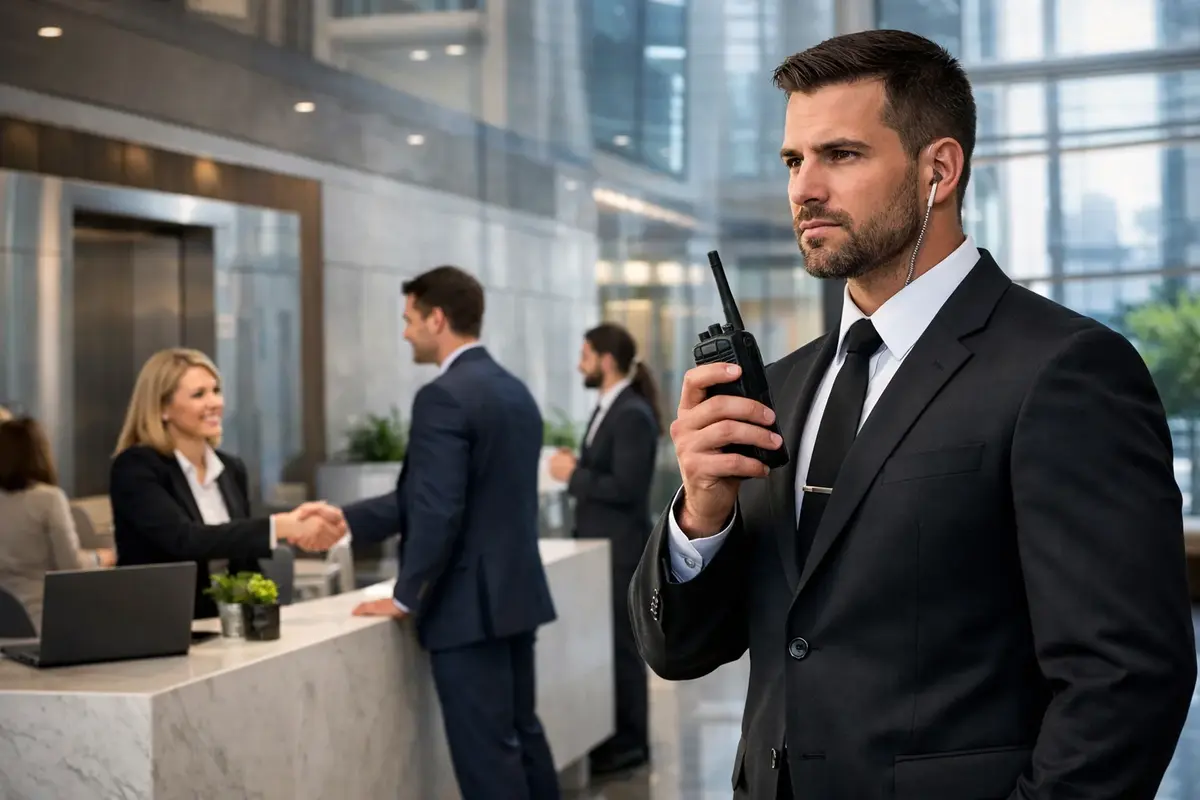
Walk into a modern office building in Grafton, and the first thing noticed usually isn’t the architecture or the signage. It’s the presence at the front desk.
That approach is called Corporate Concierge Security. It blends professional security expertise with front-desk hospitality. The result? A workplace that feels safe, organized, and welcoming at the same time. In a modern corporate setting, security teams often act as the first face visitors see.
Traditional guards often focused purely on surveillance and enforcement. Modern businesses in Grafton expect more. Offices, corporate parks, hotels, medical centers, and commercial towers now require security professionals who can combine safety, customer service, and operational awareness.
This guide explores how Corporate Concierge Security works, why it is relevant for businesses in Grafton, and how it shapes the future of corporate security service across offices and public space security environments.
Why reception security roles changed in offices
A typical office lobby used to run on a basic formula. A receptionist handled visitors, while a security guard watched the doors and occasionally checked identification. It sounded practical on paper. In reality, gaps appeared constantly. A receptionist was unable to handle safety issues, and a guard usually lacked the training to manage guests or building etiquette.
That separation of duties slowly created friction. Visitors would stand awkwardly at reception, unsure who to approach. Delivery drivers bypassed front desks because nobody managed entry consistently. Even basic building questions landed on the wrong person. Over time, building managers realized that splitting hospitality and security actually weakened both.
This is where Corporate Concierge Security began gaining traction. A single trained professional managing reception flow and access control reduces confusion immediately. The lobby becomes organized, calmer, and safer. Staff notice the difference quickly because the first interaction inside the building finally makes sense.
Balancing hospitality and security at building entry
Anyone who has worked inside corporate buildings understands the delicate balance required at the entrance. Too many security personnel make the place feel tense. Too little oversight invites problems that escalate quietly over time. The challenge lies in maintaining awareness without making employees feel like they are entering an airport checkpoint.
Professionals working in corporate concierge security spend a surprising amount of time managing tone rather than just enforcing rules. Greeting a visitor, checking credentials, and directing them efficiently may sound routine, but the way it is done changes the entire atmosphere of a building. That subtlety rarely appears in policy manuals.
Buildings that adopt corporate security often notice something interesting after a few months. Employees begin relying on the security desk for guidance. Visitors ask questions confidently. Contractors follow entry procedures without complaint. The environment becomes smoother because the security presence feels supportive rather than restrictive.
Practical duties handled by concierge security teams
A typical shift in corporate concierge security rarely unfolds exactly as planned. The morning might begin with routine visitor registrations and access badge checks. Within an hour, a courier delivery might arrive without documentation, a contractor could show up early for scheduled maintenance, and an employee might forget their building pass.
Handling those moments requires situational awareness more than rigid procedure. Concierge security professionals quietly assess what needs attention first. A delayed delivery might disrupt an entire office floor. A contractor entering the wrong area could cause safety issues. Small decisions at the reception desk ripple across the building.
Many corporate managers underestimate how frequently those small operational issues occur. Buildings without corporate concierge security often push these tasks onto administrative staff who were never trained to manage them. The result is slower responses, inconsistent access control, and occasionally awkward security lapses.
Common mistakes businesses make with lobby safety
One of the more common mistakes businesses make is assuming that technology alone can secure a building. Key card access systems, surveillance cameras, and automated visitor kiosks certainly help, but they rarely replace the judgment of a trained professional observing daily activity patterns.
Sometimes, companies install these systems, thinking the job is complete. A few months later, building managers start noticing unusual visitor traffic, tailgating through secure doors, or contractors wandering through hallways. Technology recorded the events perfectly, but nobody responded in real time.
That gap often leads organizations to explore corporate concierge security after the fact. Human presence at entry points bridges the gap between surveillance and action. Observational awareness, polite questioning, and simple verification prevent situations that automated systems often miss entirely.
Costs, staffing realities, and budget trade-offs
Budget conversations inevitably appear whenever security upgrades are discussed. Some business owners hesitate at the cost of maintaining corporate concierge security staffing, especially in smaller commercial buildings. The hesitation is understandable. Security budgets compete with maintenance, technology upgrades, and operational expenses.
What rarely gets calculated properly is the cost of inefficient building management. Uncontrolled access can lead to safety incidents, lost productivity, or property damage. Even minor disruptions add up across months. Buildings without consistent front-desk oversight often spend money reacting to problems rather than preventing them.
From a practical standpoint, Corporate Concierge Security often stabilizes operational costs rather than inflating them. Visitor processing becomes faster. Building access stays organized. Maintenance contractors follow structured procedures. These improvements may not appear immediately on a financial spreadsheet, but they influence daily efficiency across the entire workplace.
Difference Between Traditional Security and Concierge Security
Many businesses still wonder how concierge security differs from regular guards.
The table below explains the difference.
| Feature | Traditional Security Guard | Corporate Concierge Security |
| Visitor interaction | Minimal | High interaction |
| Reception duties | Rare | Common |
| Customer service | Limited | Strong focus |
| Access control | Yes | Yes |
| Building support | Basic | Extensive |
| Public spaces security | Moderate | Advanced monitoring |
Traditional guards focus mainly on surveillance and patrols.
In contrast, Corporate Concierge Security combines protection with service. This dual role improves safety while enhancing the workplace experience.
Training standards behind concierge security roles
Working in corporate concierge security requires a slightly different mindset compared to traditional guard work. Technical training still matters—incident reporting, conflict de-escalation, emergency procedures, but soft skills play a surprisingly large role in daily performance.
A concierge security officer may greet dozens of visitors in a single morning. Some arrive relaxed, others rushed, and occasionally someone arrives frustrated before even reaching the reception desk. Managing those personalities without escalating tension becomes part of the job description.
Training programs for corporate security increasingly include communication techniques, situational judgment exercises, and behavioral observation skills. Those elements help officers detect unusual activity without relying purely on formal identification checks.
Corporate Concierge Security improving visitor flow
Office hubs often face sudden, erratic spikes in guest volume. Between early meetings, vendors, and repair crews, everyone tends to hit the lobby in the same brief window. Lacking a solid plan, reception desks end up feeling cramped and chaotic.
Corporate Concierge Security professionals streamline that process by guiding visitors immediately through registration and access procedures. A well-managed reception desk prevents the familiar scenario where guests linger awkwardly while employees search for meeting rooms.
Over time, structured entry procedures shape visitor behavior as well. Frequent vendors learn the check-in routine. Delivery drivers understand where to report. That consistency reduces delays throughout the building and keeps internal operations running smoothly.
Industries That Benefit from Concierge Security
Many sectors rely heavily on corporate concierge security because of high visitor traffic and busy environments.
Common industries include:
- Corporate offices
- Commercial buildings
- Government facilities
- Medical centres
- Education institutions
- Financial institutions
- Shared office spaces
Each of these environments requires strong corporate security service capabilities along with professional public interaction.
Technology working alongside concierge professionals
Security technology has improved dramatically recently. Modern access control systems, digital visitor logs, and real-time camera monitoring all support building safety and help maintain Workplace Health and Safety Guidelines. Yet these tools need human oversight to operate effectively.
Concierge security professionals interpret data rather than simply recording it. An unfamiliar visitor badge might trigger a quick verification call. A security alert might indicate a door left open rather than a genuine breach. Context matters more than raw information.
In buildings where corporate concierge security is active, technology acts as a supportive tool rather than a substitute. Surveillance cameras stretch the team’s reach far past the front desk, but it’s the trained professionals who actually interpret the data and step in when needed.
Corporate Concierge Security shaping workplace culture
Something subtle happens inside offices where Corporate Concierge Security operates consistently. Employees begin noticing a sense of structure around the building entrance. Visitors follow a routine. Contractors verify before accessing restricted areas. Deliveries reach the correct departments faster.
That order gradually influences workplace culture. Staff feel more comfortable bringing clients into the building because the reception area functions smoothly. Building management receives fewer complaints about lost visitors or misplaced deliveries.
Even small details contribute to that shift. A friendly greeting at reception sets the tone for the day. Clear visitor procedures prevent awkward misunderstandings. Over time, Corporate Concierge Security quietly becomes part of the professional identity of the workplace itself.
Conclusion
Today’s offices require far more than just the basics. Companies now look for systems that safeguard assets, handle guests, and uphold a polished atmosphere.
Corporate Concierge Security bridges the gap between hospitality and solid protection, making offices feel safer without losing that inviting, orderly touch.
Across Grafton, companies rely on concierge security to support visitor management, public space safety, and daily operations. A professional security presence protects people and property while maintaining a polished corporate image. Contact us today to strengthen workplace safety.
Frequently Asked Questions
1. What is Corporate Concierge Security?
Corporate concierge security is a professional security approach that combines building protection with front-desk concierge services. Security officers manage visitor entry, monitor access points, and assist guests while maintaining workplace safety in corporate environments.
2. Why is corporate concierge security important for businesses?
Corporate concierge security improves workplace safety while creating a welcoming environment. Businesses benefit from controlled visitor access, improved public space security, and a professional front-of-house presence that supports both employees and guests.
3. How does a corporate security service support office buildings?
Managing entry points, vetting visitors, and handling emergencies on the fly is precisely where corporate security service shines. These professionals not only safeguard the site, but also ensure the smooth operation of the entire building.
4. What areas do concierge security officers monitor?
You’ll find these security teams watching over entrances, lobbies, shared hubs, elevators, and parking zones. Because of the constant flow of employees and guests, these spots specifically need high-level public space security to stay truly protected.
5. Is Corporate Concierge Security suitable for small businesses?
Yes. Even smaller companies benefit from corporate concierge security when operating in shared office buildings or public environments. The service improves visitor management and strengthens overall workplace security.